
Saad Khan × Mona Chalabi | Dazed MENA
by Khajistan Cultural Desk
·
Originally published in Dazed MENA, issue 02, on January 13, 2026.
Text Selma Nouri
Say as-salamu alaykum, New York! A SWANA revolution is upon us and, if X user @sourhoestarter is right, every white boy in Brooklyn is about to learn how to pronounce ‘biryani’. Since Zohran Mamdani’s recent victory, the city has been buzzing over what this moment truly represents. Some insist that woke is back, but I would argue that his win signals far more than just the resurgence of democratic socialism in NYC.
Only a decade ago, the prospect of a Muslim mayor was unthinkable. In recent years, however, increasingly vocal and unapologetic members of the SWANA community have refused to accept inherited models of coloniality, collectively insisting that enough is enough—especially since 2023. Two figures who embody this movement toward humanism and unapologetic self-representation are Mona Chalabi and Saad Khan.
Although they originate from different parts of the SWANA region (Iraq and Pakistan, respectively), both now reside in New York, where they assert visibility for narratives that have long been pushed to the margins. Through her Pulitzer Prize-winning work as a journalist and illustrator, Chalabi is redefining engagement with data by centring emotion as an essential component of analysis. Khan, as a filmmaker and founder of the Khajistan platform, employs archiving as a means of reclaiming and preserving the social and intellectual heritage of SWANA, as highlighted in our inaugural issue.
Together, their work points to a cultural revolution that long predates the mayoral election—one in which vulnerability, intimacy, eroticism, and the profane are no longer marginalised. As a SWANA cultural resurgence commences in America and, perhaps, globally, the two reflect on the strategic playfulness of propaganda, the implications of Mamdani’s win, and more in this raw and unfiltered exchange.
Saad Khan in conversation with Mona Chalabi for Dazed MENA.
Saad Khan (SK): Hi Mona!
Mona Chalabi (MC): Hi, how are you?
SK: I’m good. Are you in New York?
MC: I am actually in London right now. I just got back two days ago. I managed to stay for the [NYC mayoral] election, which was amazing. Are you in the city?
SK: Yeah. I live in Jackson Heights, but I wasn’t at the election party. Is that what you stayed for?
MC: Yes! I was actually thinking of writing a piece about it. To be honest, the party was probably the least interesting place to be that night. It actually wasn’t great. It was incredible winning and all, but to be there, for the moment when it was announced that he won wasn’t really the vibe.
SK: Hmm, that is interesting. I want to begin by saying that I love your work. I am such a big fan. I have so much respect for you.
MC: Likewise! In fact, as soon as Selma got in touch, I told her that I had already been an owner of this for a while [holds up American War Propaganda Leaflets published by Khajistan Press]. She only got in touch a couple of days ago, so trust me, there is no way I could’ve gotten this to London in time, even if I wanted to fake it. I love this book. It’s incredible.
SK: Wow! Thank you. You know, Mona, we’re publishing two more books in the same sphere of propaganda. I really love working with this topic because we grew up surrounded by it. I was raised in Lahore, and lived there for 24 years. And I always say, people here in the west are only now realising that propaganda exists. But growing up in Pakistan, you quickly learn to always be aware of what is happening around you.
I remember being in the third grade at a missionary school. My teacher, a Christian, was teaching me Islamic studies and, on the board, wrote something along the lines of “Jews and Christians can never be your friends”. I was sitting next to my Christian friend at the time, and I nearly covered his eyes. I think that’s when I first understood how deeply propaganda surrounds us, so it’s baffling to me that people are only now waking up to this.
Anyway, we’re working on another book, essentially a collection of stickers we’ve gathered and archived over the past two years from across the streets of New York: zionist stickers, anti-zionist stickers, Palestine stickers. We’ve archived roughly 400 of them and compiled them into this book.
From the Khajistan archive.
MC: Oh, wow! You know, I actually designed some Palestine stickers myself. I had them on my Instagram highlights, but I took them off last month when I was trying to go to Palestine. It was a project I did three years ago, maybe even longer. Well, I might as well put them back up since they didn’t let me in anyway.
Basically, it was a sticker I designed to place on different food products. This was before October 2023, so I do wonder how I would approach the design now. The idea was that you could print the stickers and put them on Israeli products in supermarkets. But yes, I really feel like stickers are incredibly powerful. I’m sure we’ll get into that in our discussion, but I think there’s a lot we can talk about when it comes to propaganda.
SK: For sure, yeah.
MC: As you said, a lot of people in the west are only just beginning to wake up to this possibility, yet they often can’t seem to backdate their understanding of propaganda—that it didn’t start now, but is actually a very longstanding practice. I think something interesting is happening in the UK, where people are suddenly like, ‘Wait a second, maybe the BBC is part of this? Maybe they’re involved in this broader system of propaganda?’ For those of us who were born outside the west, or who had parents raised under various forms of oppressive regimes, we grew up with a completely different understanding of – and relationship with – information itself, you know?
SK: We’re definitely more critical, or at least more aware, of the fact that so many people around us are lying. It’s part of the societies we grew up in. You realise early on that even your elders aren’t always telling the truth. I’ve basically learnt to question anyone who’s older than me.
Selma Nouri (SN): On the subject of lies and propaganda, Mona, I am really curious to know how you first became familiar with Saad’s work, especially since the book you own by Khajistan is one that deals directly with the use of propaganda during America’s war on terror.
MC: Saad, did you have an event for the book at Printed Matter in New York last year? I was so gutted because I was out of town for it, but just seeing the announcement, I thought, What the f*ck is this? I immediately ordered the book and familiarised myself with your work, and I think that was probably around the time I started following you. Honestly, I’ve been quite late to the game, but now I’m fully in it, and I’m so happy to be here.
SK: Yeah, we hosted a launch event at Printed Matter last year! It’s funny, though, I actually had no idea they had posted about the book or the event since I wasn’t tagged in anything. I happened to arrive a bit late and, by the time I got there, the book was already sold out. The turnout was great.
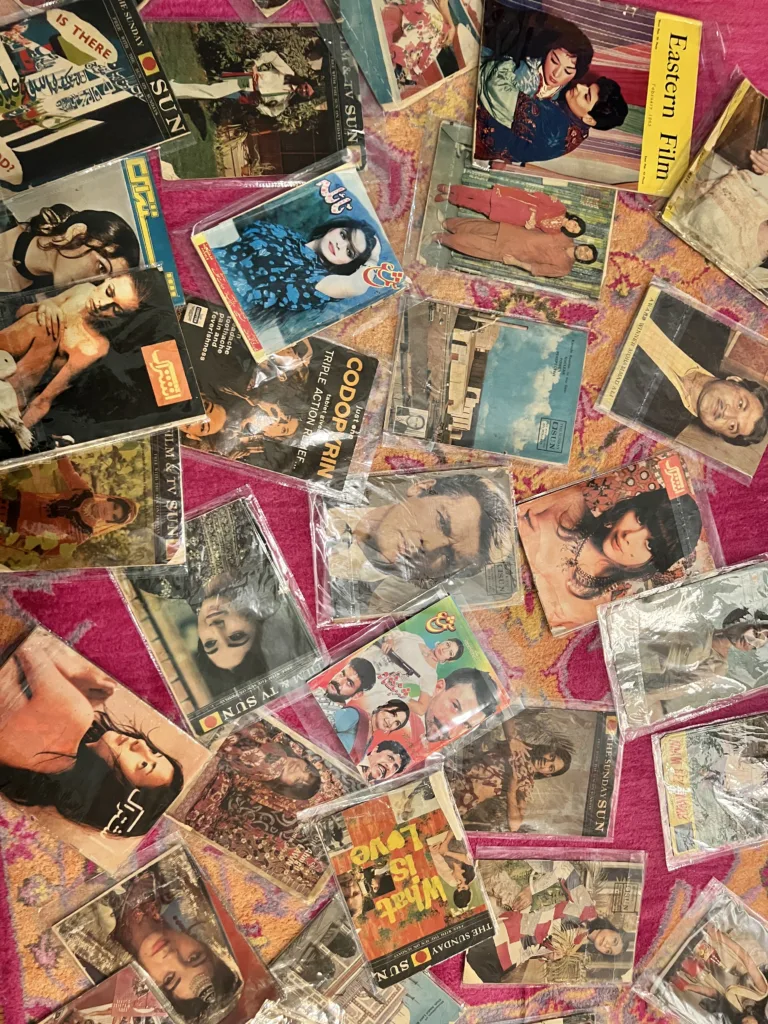
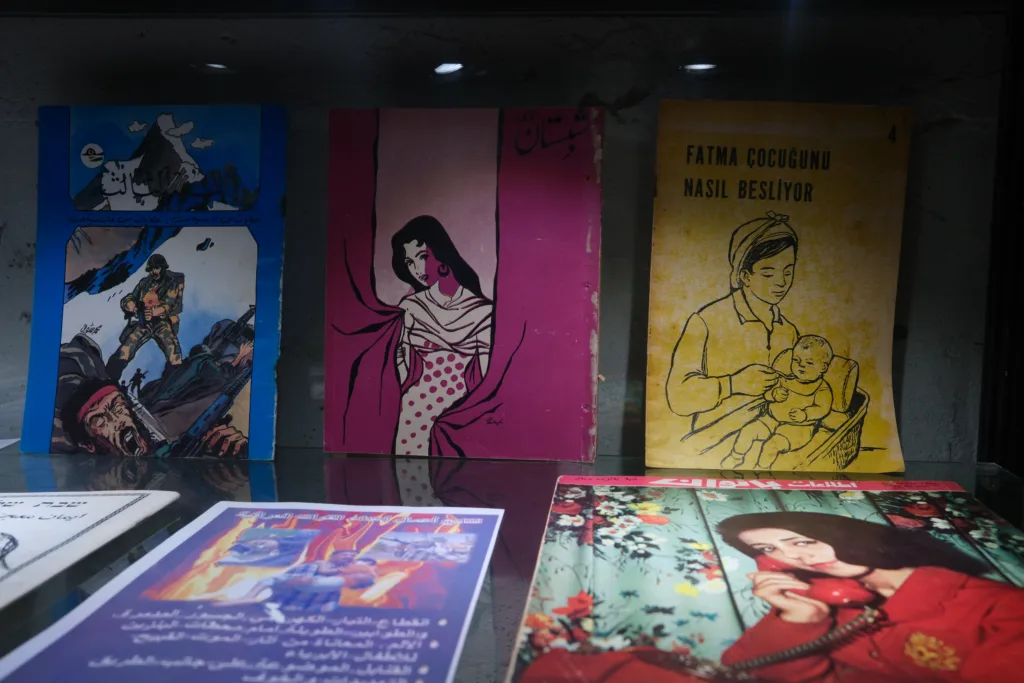
I think that juxtaposition is really what it’s all about. I recently did a show here in NYC at the SculptureCenter, where we basically filled the basement with overlooked, banned, or censored audio-visual and print media from the Persianate world – Pakistan, Iran, and Afghanistan primarily – while incorporating significant artefacts from the broader Arab world. The idea was to place erotica alongside gathered pamphlets, large canvases, or street propaganda from the region. For instance, we displayed Afghan and Pakistani erotica from the 90s next to Iranian propaganda books, which really conveys what life is like on the ground—so much intense stuff happens and exists, but alongside, there’s also beauty, humour, and a sense of frivolity.
From the Khajistan archive.
MC: I agree, and I’d say that there is a point of similarity in our work, this idea that there is a constant coexistence of high and low. And it’s not just about placing two seemingly incongruous subjects side by side; it can even exist within a single subject matter. Take the book, for example. The design of the propaganda leaflets can feel quite sober in some ways, but the absurd is already embedded inside. There are borderline comical examples in here.
Of course, it’s not funny when you consider the damage they’ve caused, but in terms of design, some of them are literally laughable. I’d also say this is something I’ve felt tension with in my own work. I create illustrations about really dark subject matter, yet there’s almost always a playfulness to them. I think the obscene is very often absurd. I mean, violence in itself carries its own kind of absurd logic.
SK: I truly believe that you cannot engage with dark subject matter without a sense of playfulness. When I first began my work in archiving, I even wrote a manifesto that ends with ‘let’s play’ because I realised that, after so much suppression, what I’m doing by archiving violence is inherently playful.
In fact, I recently witnessed this playfulness in real time during the India-Pakistan conflict. I was talking to my family in Lahore and Islamabad while drones were flying over them and, instead of shrinking in fear, they were joking. I mean, Pakistanis everywhere were creating an incredible number of memes that were eventually picked up by the media as well.
MC: It’s a survival tactic! It’s also a strange form of resistance. Anyone who has spent time in Lebanon, for example, knows this. Lebanese people, their sense of humour is pretty f*cking dark. They can make some very, very dark jokes about even the darkest situations.
SK: You know, that was really the main focus when I started Khajistan. I wanted to show that, regardless of war, suppression, or economic hardship, life goes on. But what does that life actually look like? For years now, kids – Gen Zers mostly – from Pakistan, Afghanistan, and Iran have been sending me snapshots of their everyday lives. Often, they’re just small, funny moments, things that keep hardship from completely overshadowing. But I think you really need a certain gaze to truly appreciate that kind of humour.
And that’s what I love about your work, Mona. It harnesses emotion and playfulness to engage a wider, often western audience, revealing just how tangible propaganda really is. It’s profoundly eye-opening, especially for those who have spent their entire lives surrounded by lies.
MC: I think it’s also crucial to recognise that propaganda doesn’t just affect the wealthy. Our understanding of – and I’ll use big air quotes here – ‘developed’ and ‘developing’ countries is deeply skewed. Yes, economics plays a role, but much of how those lines are drawn comes down to access to free information and free press. And when the realities of western propaganda, doxxing, and all the lies begin to unravel, the lines between ‘us’ and ‘them’ suddenly start to crumble in a profoundly different way.
SK: I am sure you’ve spoken about this before, but why are you interested in propaganda?
MC: It’s funny because I sometimes wonder if part of what I’m doing could be considered propaganda and how I feel about that word, with all its positive and negative connotations. I’m sure you have a more nuanced definition of propaganda, and maybe it’s only propaganda when it’s designed to serve specific goals. One thing, I feel, propaganda does remarkably well is play with emotions—and I mean emotions in the broadest sense, even nostalgia.
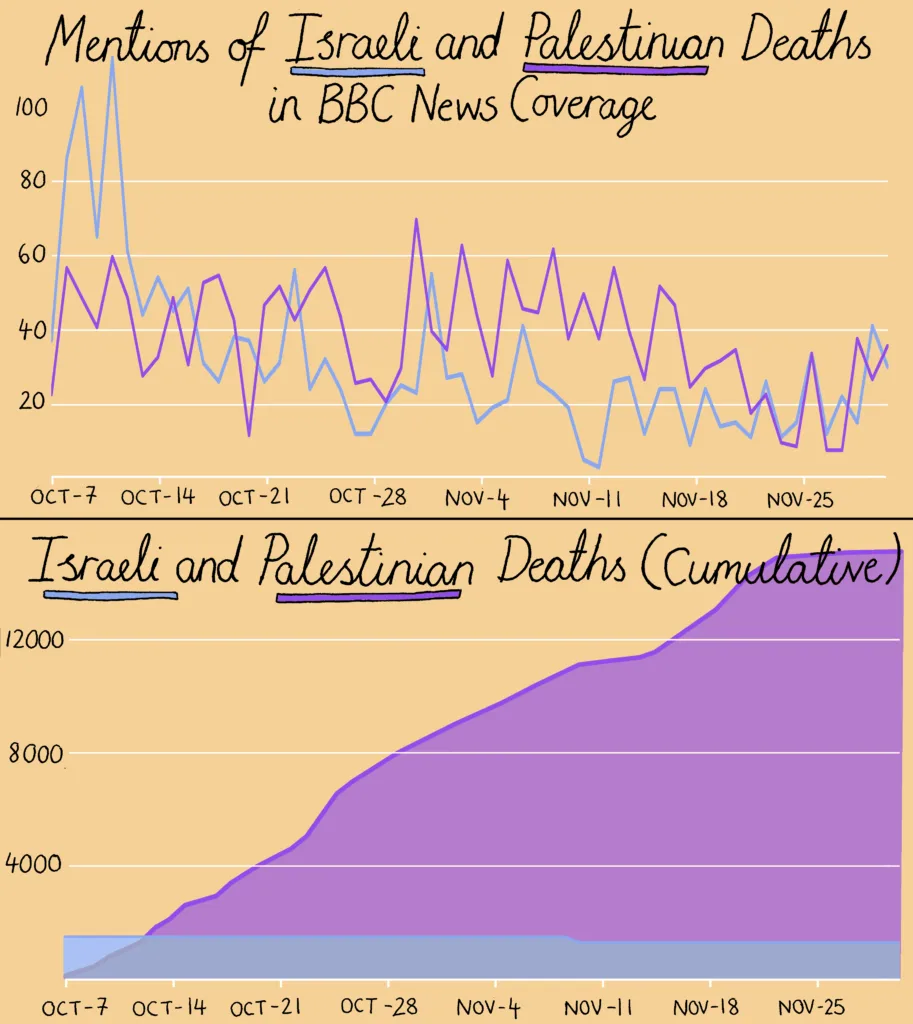
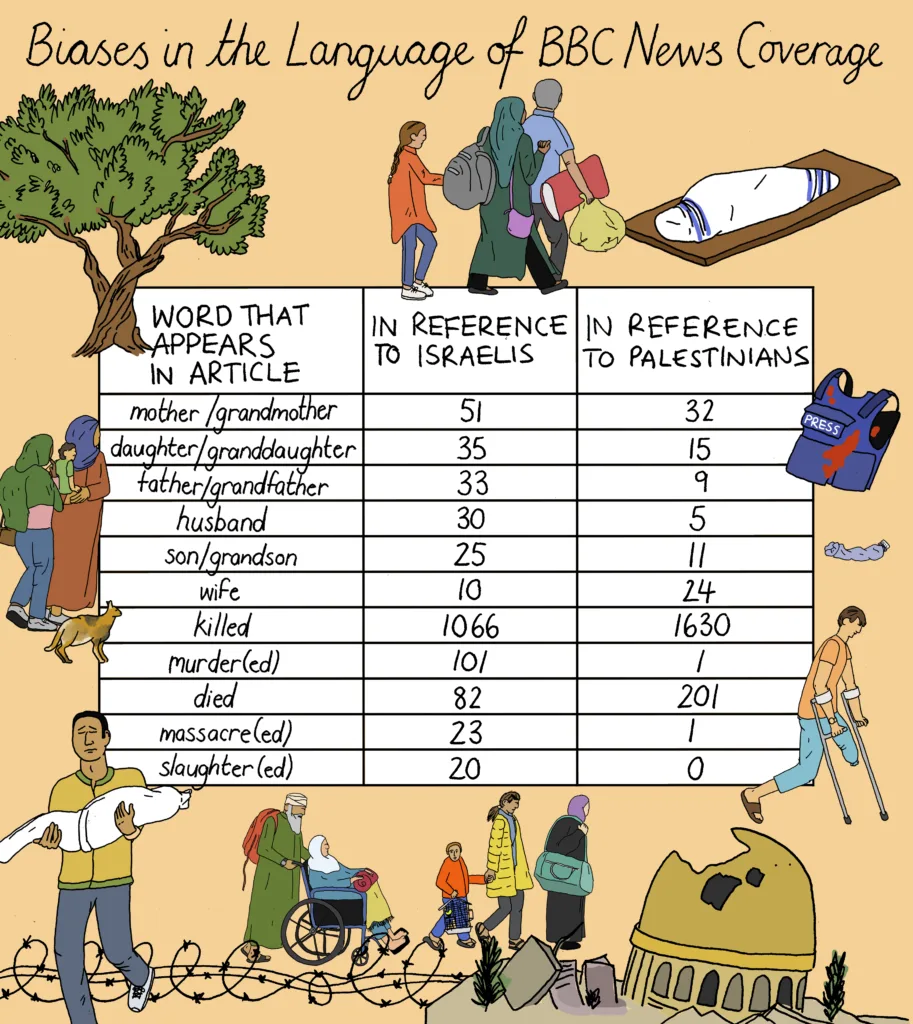
For example, when the BBC calls Tony Blair the “viceroy” of Gaza, there’s a lot happening in that single word. It’s trying to evoke a different time in history, deliberately using a term that, let’s face it, most viewers probably don’t know. I caught myself thinking, Wait a second, do I even know what a viceroy is? In a way, that word almost deliberately alienates people. It’s like the BBC is saying, “We know what this means, so you mere mortals just have to keep listening to us to understand it.” At the same time, it holds an emotional, nostalgic grip on the audience.
The reason I view my work as connected to that is because when I first got into data journalism, everyone was making charts that intentionally felt clinical because that was supposedly what made you a ‘better’ journalist. But I’ve always felt that my role isn’t just to report something. It is to convey the emotional impact of an event. My charts are meant to make you feel something, and I don’t see that as manipulative or exploitative because what I am trying to evoke is very upfront. In a way, The New York Times also tries to make you feel something through its choice of words, but there’s often this pretense of neutrality in the simplicity of its designs.
By contrast, when I use characters, colour, and composition, I’m actually being more transparent about my intent. If I’m creating a chart about, say, which items are prohibited in Gaza, I might make it look like a children’s book because I want you to think about the children who are deprived of basic goods. It’s not subtle. I have no intention of ever hiding that.
From the Khajistan archive.
SK: That’s interesting. It actually reminds me a bit of how Saddam used children’s books in Iraq.
MC: Actually, I’m Iraqi, and I still have Iraqi children’s books. The way I learned Arabic was through books that had made their way out of Iraq. You open the book, and the first thing you see is praise of Saddam alongside a photograph of him sitting on a couch, surrounded by children. It’s insane.
SK: Yes!
MC: I always wonder: what does that do to you? Every single time you sit down to learn that two plus two equals four, you have to see Saddam Hussein before you even get to the math.
SK: You know, the Americans did something similar in the 80s. They sent books to Afghanistan and other parts of the region to radicalise kids and teach them about jihad. They created close to 200 titles, and I actually have one, The Alphabet of Jihad. It’s crazy, it has pages teaching kids terms like shaheed and takfiri. Even we didn’t know what a f*cking takfiri was!
I guess propaganda is produced by everyone and exists everywhere. And I think, Mona, what you end up doing is stripping away that fake neutrality that The New York Times and other media outlets pretend to adopt with their western-centric listicles and articles. In your work, you’re wiping away that veneer and making room for a wider sentiment. And I think that’s what I’m doing, too, just by archiving. We’re making room for emotion, creating space for nuance and feeling in places where that is usually not afforded to us.
MC: That drives the question of what neutrality is. I did a Q&A with a BBC journalist who was driving me f*cking crazy this summer. It was at some literature festival. I kept thinking, You can say that killing children is wrong because you can point to a UN convention and factually prove that it’s wrong, but does it distress you, as a human, to be reporting on the killing of children? Do you want your work to contribute to stopping that? Or do you believe that your work is entirely separate from its consequences in the real world?
A lot of journalists seem to think neutrality implies making the thing, and however those words or images live out in the world isn’t their responsibility. And I completely disagree with that. I think, as a journalist, you have to be thinking about the impact your work has once it leaves your hands—how it might be misunderstood or how it might contribute to misinformation, racism, transphobia, and homophobia. What is your work doing once it’s published?
SK: They really do believe journalism is neutral. And it isn’t. You still have rights and duties as a human being or civilian, but they seem to sort of strip themselves of that. It reminds me of that photo of the starving Sudanese child with a vulture waiting nearby, and the photographer who took it later killed himself. It’s that same conundrum, I think. Right?
MC: I think it’s interesting because there’s a much longer lineage of grappling with responsibility in photojournalism specifically. So, for example, the Afghan girl who ended up on the cover of Time or the man at Tiananmen Square, there’s a whole history of asking what happened after the fact. It’s different with more traditional forms of journalism, though. I can think of another data journalist who makes a chart about, say, the number of hospitals destroyed in Gaza, and they’re not held to the same level of responsibility as a photojournalist because there isn’t one individual at the centre of it.
We’re just not good at dealing with systems—we tend to look away when responsibility is systemic. But I actually think all journalists should be grappling with the exact same questions: How did your chart contribute to either legitimising or delegitimising the actions of Israel? How did your colour choices, your sizing, your font shape the way the reader understood the conditions of people in Palestine?
Professionally, I’ve spent my entire career as a journalist in newsrooms, surrounded by people who feel very strongly that what they’re doing is righteous and just. There’s this wholesale acceptance of certain methods and ways of doing things. Yet, I’ve also been in those exact spaces when the same people insisting on neutrality are simultaneously expressing their racism and Islamophobia. Right in front of me, they make it abundantly clear that they view my people as backward and violent, you know?
SN: Having spoken to a lot of artists and intellectuals from the SWANA region, I’ve noticed that many explicitly state that they are not creating work for the western gaze or to change the minds of people in the west. But one could reasonably argue – to the point of scholars like Edward Said – that the west’s perception of the Arab world, Palestine in particular, does fundamentally have an effect on politics and, therefore, the socio-political realities experienced by people in the diaspora and across the region. I’m curious to hear your thoughts on this.
MC: There are two points I want to touch on here. You mentioned talking to people who take issue with creating work for the west, as well as work that’s meant to change people’s minds. To me, those are two different things entirely. A lot of my work, for instance, is made with a western audience in mind, and I mean that in the broadest sense—including people like me who live in the west but aren’t necessarily of the west, or who have a complicated relationship with it.
Since you mentioned Palestine, let’s take my work on the genocide as an example. When I talk about it being ‘propaganda-adjacent’, I don’t mean that I’m trying to convince a zionist to care about Palestine. That would be an enormous waste of my time, energy, and resources. I’m not trying to change people’s minds. I actually gave up on that idea a long time ago in my journalism career. The first Trump election was pretty pivotal for me in realising that I wasn’t interested in changing minds, especially not minds that are already 180 degrees in the opposite direction.
What I am trying to do is nourish and sustain the people who are questioning these systems, who are actively trying to dismantle structures of injustice. I want to create work that gives them the energy to keep going, and the information to keep going. I see myself as part of a community, and my work is often made for that community. Sometimes, my work isn’t even about telling you something new; it’s about reminding you of something you already knew as this kind of tool or boost of strength. So, yes, I really want to differentiate between those two things. Making work for people in the west is not the same as trying to change people’s minds.
SK: I want to add to that. Maybe this is a bit philosophical, but I don’t think the world is divided into a clear east and west anymore. The east exists within the west, and the west exists within the east. And you know how you just said you had that moment where you realised you weren’t trying to convince certain people anymore? I had a similar realisation when I was making my film, Showgirls of Pakistan, a documentary about dancing women in Pakistan and how they perform in state-controlled halls before going to other cities to dance in bars, navigating patriarchy in each place.
Just dealing with broadcasters in general, European and American, I kept running into the same thing. I went to these film festivals to pitch the project and heard so much racist sh*t. People were talking about Sharia law, and I’m standing there exhausted, thinking, We don’t even really have Sharia law in Pakistan. That was the moment I realised I didn’t want to keep doing this, so I ended up making the film in a visual language that was legible to the people who are actually in the movie—not to PBS, HBO, or the old white gatekeepers who might be watching it. That was the pivotal point for me.
MC: I think it’s important to add a caveat here: even though I’m not trying to change people’s minds in the west, I am still hyper-aware of their prejudices and the ways my work could unintentionally feed into them. And that awareness is, in its own way, a form of oppression. For example, I haven’t made a chart on the rates of domestic violence in different Arab countries. But that data is real, there are women in those countries who want that information to be highlighted—it’s a genuine struggle they face.
And yet, it’s f*cking shit that if I were a white female journalist, I would have no problem covering rates of domestic violence across different US states because that’s considered a story worth telling. But for me, I end up not serving some members of my own community simply because I know that the moment I publish that kind of work, it becomes exactly the kind of narrative the west is eager to weaponise.
SK: And CNN is going to do it anyway.
MC: Exactly. The thing is, I know I can tell that story better than CNN. I could tell it in a way that is accurate, responsible, and grounded. But the mere headline has the potential to harm our communities, so I choose not to touch those stories. And that choice, too, becomes its own form of oppression and self-censorship.
From the Khajistan archive.
SK: Yeah, it’s incredibly oppressive, those constant micro-decisions we’re forced to make. Do we cover this or not? How will it be perceived? What will it be used to justify? We simply don’t have the same freedoms that white journalists or artists do.
MC: By the way, this has come up a lot during the genocide as well. Let me give you an example. In any situation where societal infrastructure has been destroyed – prisons bombed, hospitals gone, schools gone – everyone who was previously incarcerated is now released, and people’s homes are no longer safe. They’re living in tents. And in these conditions, you are inevitably going to see a massive rise in gender-based abuse—that, too, is part of the story of genocide. I think about how unsafe so many Gazans are right now and, yet, I’m not writing that story. It breaks my heart because it’s an essential part of conveying the full horrors of what Israel has done. But I just can’t bring myself to do it.
SN: That’s really interesting because I was actually going to raise the question of fear—the fear of perpetuating or reinforcing prejudice specifically. Do you ever feel conflicted, or even guilty, about criticising the SWANA region in your work? Are you ever hesitant because you don’t want to reinforce existing stereotypes?
MC: I’m happy to criticise the region, but I don’t want to do it in the same way as the west. We see this all the time when we write stories criticising the aunties who tell us we’re ugly or hairy or whatever because that’s real and specific, not something imagined by the west. But even then, that’s still its own form of oppression and self-censorship. I also want to make a clear distinction between my public professional work and my private professional conversations. In private spaces, when we meet and talk about improving the lives of our family members and communities or when we discuss how to respond to the genocide, everything is on the table—which aid organisations to support, what actions to take, all of it. But if I’m publishing a piece in The Guardian, there are things I simply won’t write about.
SN: That makes a lot of sense. Speaking of stereotypes and censorship, Saad, one thing I’ve noticed is that while much of your practice involves archiving posters related to war and propaganda, another important aspect is collecting erotica. For instance, in your latest exhibition, you included the first X-rated Pakistani film and erotic magazines from the region. I’m curious, what draws you specifically to that category of work, and why do you think it’s valuable to preserve?
SK: It’s not just about erotic material. We also archive things related to non-heteronormative desire and madrasas, which are Islamic seminaries. In fact, we have a huge collection of madrasa materials since many of them have their own press branches producing books with really important knowledge. The bottom line is, Oxford University Press isn’t going to translate or archive these works, and they rarely make it into mainstream libraries. The materials we preserve carry knowledge from the streets, the kind I grew up hearing from kids, about intimacy, death—everyday realities. I believe safeguarding that knowledge is vital, alongside the erotic material.
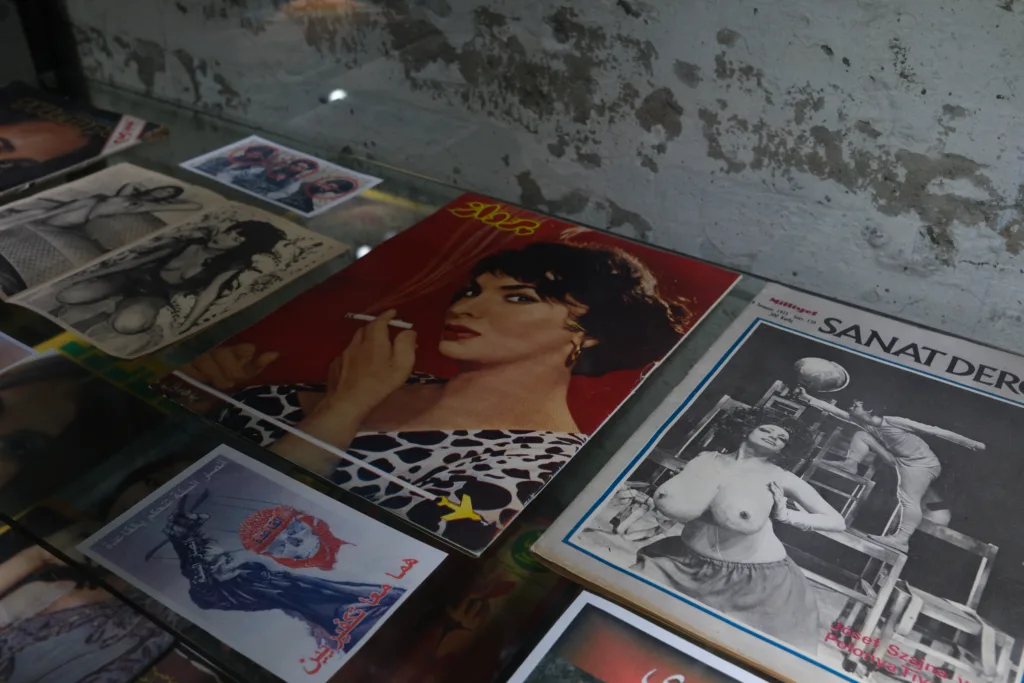
When I think about it, the common thread running through everything I collect is suppression. I’m fundamentally against the censorship of content. For instance, we’re putting together a book called Smut From Pakistan that’s coming out in December. It features over 400 banned or suppressed magazines from the 70s, 80s, 90s, and early 2000s, capturing life under two different dictatorships and the distinct forms of suppression that accompanied each. The book highlights independent magazines and press that emerged during those periods, often featuring erotic or ‘smut’ material. From a western perspective, many of these images or editorial shoots wouldn’t even be considered smutty, yet even a hint of cleavage would be censored with cross-hatching or sensorial mesh.
MC: Which makes it so much more interesting!
SK: Yes! The editorial interventions actually make the images feel even more erotically charged, and these are exactly the kinds of nuances that fascinate me. What we’re collecting at Khajistan isn’t explicitly erotic – or maybe it is – but it becomes erotic when editors creatively navigate the censorship laws imposed on them. For example, they might take a photo and overlay an intricate, artistic sensorial mesh, so that when the censors come, they think, Oh, the cleavage isn’t showing. The image then reaches the readers who, in turn, draw on it or incorporate their own imagination.
That layering of creativity really intensifies the erotic charge of the image. And my focus, as I’ve said, is really on those minute details, the inner worlds we carry. Regardless of your politics, I’ve learned that our inner worlds are shaped by everything around us. In many ways, I’ve realised that much of my own work is a love letter to my father and my brother, who I don’t really speak with anymore because they both have such complicated politics. Take my dad, for example. He has an anarchist mentality, yet he’s extremely opportunistic. He hates capitalism but still wants money. All these contradictions and the inner worlds he carries, I think, come in part from not being dealt a good hand by the economy, colonialism, or the state. And yet, I get to glimpse those inner worlds every day through his WhatsApp stories. The memes he creates, which I share on Khajistan, are crazy and unhinged, but I believe everyone has a right to have their inner worlds visible in the built environments we inhabit.
Technology moves so fast that people’s inner worlds, or subcultures, aren’t recognised at the same pace, and that dissonance makes them feel increasingly isolated in these new worlds we keep creating. Yeah, so I collect, archive, and create as a way to contextualise my own existence. And it’s the same with the collectors I work with across Pakistan, Afghanistan, Iran, Egypt, and Lebanon. If someone is trans, atheist, or part of a religious minority, and they focus on collecting something deeply tied to their childhood, it helps them understand and realise their inner worlds. It validates them. And that validation is, to me, incredibly important.
MC: You render their inner worlds visible, and that’s really powerful.
SK: What I’m really against is cultural imperialism. I struggle when something is created purely in reaction to the west, when people or governments are so fixated on what the west is doing that whatever they end up producing – or imposing on their own people – is just a response. Everything becomes reactionary, and that’s harmful in my opinion. Even if it’s done with good intentions, it’s ultimately a waste of time. There’s so much beauty and nuance in our own region, and we need to embrace each of them unapologetically.
MC: I agree. And this is exactly why watching Zohran win was so beautiful. I haven’t seen him doing backflips to try to prove that Islam is a religion of peace. He’s just like, “Hi, I’m Zohran. I’m Muslim by the way, but I don’t need to explain why that doesn’t make me a misogynist.” He’s unapologetic. He’s not saying, “Yeah, I’m an immigrant, but I’m a good guy.” He’s just fully himself, embracing it all. And I hope we can continue moving forward in that spirit, refusing to allow others to set the terms of the debate.
SK: I really do hope so.
SN: I actually wanted to touch on this subject before we close. What do you think his win means for the city and perhaps even for global politics?
MC: The fact that he was even asked foreign policy questions is absurd. He’s the mayor of New York. He shouldn’t be expected to answer for global geopolitics, but I really hope his victory serves as a lesson for the global left. It reminds me of the recent Irish election, during which the headlines described the new president as “a woman who decries Israel as a terrorist state”. That’s what the right-wing press ran with and, honestly, that should be the headline. It was completely accurate and, in my view, absolutely worth celebrating.
What his victory shows, I think, is that genuinely holding leftist principles – funding public institutions, caring for the most vulnerable, and refusing to stigmatise or alienate the marginalised – can be a viable electoral strategy. And, honestly, speaking simply as a New Yorker, there’s something heartening about his win. He just seems kind and sincere, and it’s good to see someone who feels grounded in those values take power.
SK: Where I come from, I’ve seen how systems can shape or even corrupt people, so I’m always cautious. But of course, I am genuinely happy. As a New Yorker, this feels like a moment to celebrate. I just hope we don’t lose sight of the need for accountability. Still, this feels good—finally, politics with a spine.


